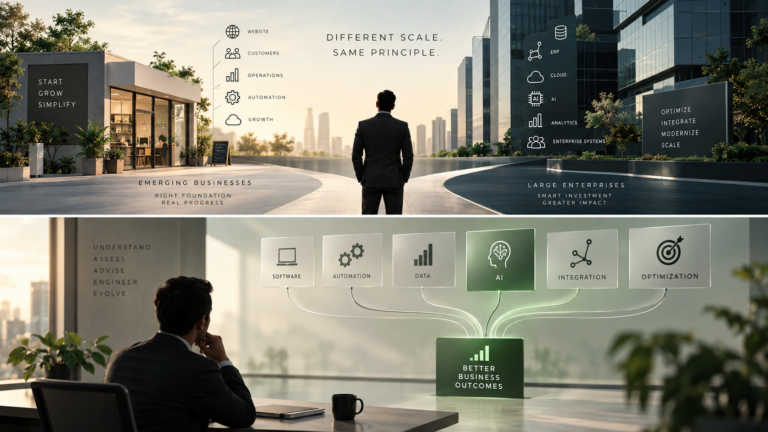



ERP software in 2027 should do more than manage business transactions. It should help businesses understand operations, connect information, and make better decisions.
Imagine running a growing business where sales are increasing, inventory is moving, and customer orders are arriving every day.
Everything appears to be progressing.
But can you immediately identify which products are performing best? Which customers have overdue payments? Which orders could face fulfillment delays? And how these situations might affect your business?
These are the questions modern ERP systems should help answer.
As businesses prepare for 2027, choosing the right ERP software will increasingly involve evaluating not just the number of features, but how effectively those features support business operations and decisions.
Let’s explore ten important capabilities that SMEs, manufacturers, traders, and distributors should consider when evaluating AI-Native ERP software in 2027.
1. Integrated Sales Management
Sales management is about more than recording orders and generating invoices.
Growing businesses need clear visibility into customer orders, sales performance, pending commitments, and revenue trends.
An effective ERP should help businesses:
- Manage customer sales transactions.
- Monitor order status and fulfillment.
- Understand product-level sales performance.
- Track customer purchasing patterns.
- Connect sales information with inventory and finance.
Why it matters in 2027: Business owners need to understand not only how much they are selling, but also whether those sales are creating sustainable business value.
The iZU approach: Connected sales workflows help businesses manage transactions and improve operational visibility.
2. Intelligent Inventory Visibility
Inventory is one of the most important operational and financial assets for trading and manufacturing businesses.
Too much inventory can tie up working capital.
Too little inventory can delay customer orders.
An intelligent ERP environment should help organizations monitor stock availability, inventory movement, and fulfillment requirements.
Important capabilities include stock visibility, product movement tracking, slow-moving inventory identification, and connections between sales demand and inventory availability.
Why it matters in 2027: Inventory decisions should increasingly be supported by connected operational information rather than isolated stock reports.
The iZU approach: Inventory management and intelligence capabilities are designed to support better visibility into stock conditions and related business decisions.
3. Finance and Receivables Visibility
A profitable business can still experience cash flow difficulties.
One common reason is the gap between sales and actual customer payments.
ERP systems should help businesses monitor outstanding receivables, payment status, overdue invoices, and customer financial exposure.
A connected finance environment can also help business owners understand the relationship between sales activity and incoming cash.
Why it matters in 2027: Financial visibility should be available when decisions are being made, not only during month-end reporting.
The iZU approach: Connected financial information and receivables analysis support better awareness of customer payment conditions.
4. Purchasing and Supplier Coordination
Purchasing decisions affect inventory availability, operational continuity, and working capital.
An effective ERP should provide visibility into purchase requirements, purchase orders, supplier information, and procurement status.
When purchasing is connected to sales and inventory, businesses can make more informed replenishment decisions.
Why it matters in 2027: Purchasing should become a coordinated business process rather than a separate administrative function.
The iZU approach: Connected purchasing workflows support coordination across business functions.
5. Connected Business Operations
One of the biggest challenges in growing organizations is fragmented information.
Sales teams may work with one set of records, finance teams with another, and operations teams with separate spreadsheets.
Even when each department performs well individually, disconnected information can create delays.
Modern ERP systems should bring operational activities into a connected environment.
For example, a customer order can be evaluated alongside inventory availability, fulfillment progress, and payment information.
Why it matters in 2027: Businesses need a connected understanding of their operations, not merely separate departmental dashboards.
The iZU approach: iZU emphasizes connected business processes that support greater clarity across functions.
6. Business Intelligence and Performance Analytics
Traditional ERP reports often focus on historical transactions.
Business intelligence adds another layer by helping organizations interpret performance, compare results, and identify patterns.
Useful analytical capabilities include:
- Sales trend analysis.
- Product performance comparisons.
- Inventory movement insights.
- Receivables analysis.
- Operational performance indicators.
The value of analytics depends on the quality of the underlying data and the relevance of the business questions being answered.
Why it matters in 2027: Faster access to meaningful business information can reduce time spent manually preparing reports.
The iZU approach: Business analytics and intelligence form an important part of the iZU product direction.
7. AI-Assisted Decision Intelligence
Artificial intelligence can extend ERP beyond reporting by supporting pattern detection, prioritization, and decision recommendations.
Consider a business facing three situations simultaneously:
A customer payment is overdue.
A frequently ordered product is running low.
A customer order is approaching its fulfillment deadline.
Each situation may appear in a different department.
Decision intelligence aims to connect these signals and help decision-makers understand which issues require attention.
However, AI-generated recommendations should be explainable, supported by reliable data, and subject to appropriate human oversight.
Why it matters in 2027: The ability to identify and prioritize business risks may become increasingly important in ERP evaluation.
The iZU approach: iZU’s broader product family includes a dedicated decision-intelligence direction through iZU – The Insight, intended to enhance analytical visibility and decision support, including alongside existing ERP environments.
8. Customizable Business Workflows
Not every business operates in the same way.
Manufacturers, distributors, trading companies, and service organizations may have different approval processes, operational priorities, and reporting requirements.
A suitable ERP should accommodate meaningful business differences without introducing unnecessary complexity.
Customization should be guided by actual requirements rather than adding features simply because they are technically possible.
Why it matters in 2027: Business fit will remain a critical factor in software value.
The iZU approach: The iZU product family includes customizable ERP solutions intended to address organization-specific operational requirements.
9. Scalable and Accessible ERP Architecture
A growing business needs software that can evolve alongside its operations.
When evaluating ERP, organizations should consider user access, deployment architecture, integrations, data protection, performance, and the ability to accommodate future requirements.
Cloud-based and SaaS delivery models can provide flexibility, but businesses should still assess security, availability, total cost, and support arrangements.
Why it matters in 2027: ERP selection should account for future growth without assuming that the most complex system is automatically the best.
The iZU approach: iZU offers a product family covering SaaS ERP and tailored business solutions, allowing organizations to explore an approach appropriate to their needs.
10. Actionable Business Insights
A business dashboard may display dozens of indicators.
But a business owner ultimately needs to know:
What requires attention?
Why does it matter?
What should happen next?
Actionable intelligence seeks to connect information with decisions and follow-up activities.
For example, identifying an overdue receivable is useful. Understanding its significance, assigning responsibility, and tracking the outcome can make that information more valuable.
Why it matters in 2027: ERP systems should increasingly be evaluated on the business actions they support, not simply the volume of information they display.
The iZU approach: The iZU intelligence vision emphasizes moving from operational visibility toward contextual insights and action-oriented decision support.
How iZU Supports the Future of Intelligent Business Management
At iZU ERP, powered by IFARA Technologies, our focus is on connecting business operations with meaningful information and intelligence.
The iZU product family addresses different business requirements:
iZU – The Core
A SaaS ERP solution for SMEs seeking connected business operations and practical management capabilities.
iZU – The Business Companion
A customizable ERP approach for organizations requiring business-specific workflows, analytics, and intelligent capabilities.
iZU – The Insight
A decision-intelligence solution designed to extend business visibility and analytical decision support, including for organizations that already use ERP software.
Together, these solutions reflect a business-first approach to ERP modernization.
The objective is not to make technology unnecessarily complicated.
It is to make business information more connected, understandable, and useful.
Individual capabilities and availability depend on the selected solution and implementation scope.
How to Choose the Right ERP for Your Business in 2027
Before selecting ERP software, businesses should evaluate their current operating environment.
Start with these questions:
- Which business processes require better visibility?
- Where are manual activities creating delays?
- Are sales, inventory, finance, and operations connected?
- Can management access reliable information when needed?
- Does the proposed software match existing business workflows?
- Can the solution support future operational growth?
- Will the expected business benefits justify the investment?
The answers can help organizations identify whether they need a new ERP, improvements to existing software, or additional intelligence capabilities.
Final Thoughts: More Features Do Not Automatically Mean Better ERP
As 2027 approaches, businesses will encounter increasingly sophisticated ERP products.
But the best software investment is not necessarily the one with the longest feature list.
It is the one that addresses the organization’s operational requirements, supports its people, and improves the quality of business decisions.
At iZU, we believe the future of ERP lies in combining connected operations with business intelligence and practical decision support.
Because growing businesses deserve more than software that records what happened. They deserve technology that helps them understand what matters next.
Explore iZU ERP for Your Business
Planning an ERP implementation, modernization initiative, or technology investment for 2027?
Explore how iZU can support your organization’s business processes, operational visibility, and intelligence requirements.
Discover iZU ERP: https://izuerp.com
Explore IFARA Technologies: https://ifaratech.com
Start with a Digital Technology Assessment to better understand your existing business systems and opportunities for improvement.
Powered by IFARA Technologies — Every Decision Deserves Intelligence.