

Businesses across South India are growing, expanding into new markets and managing increasingly complex operations. From manufacturing and wholesale distribution to retail and trading, enterprises need more than disconnected software systems to manage their business effectively.
Choosing the right ERP company in South India is therefore an important business decision. The right ERP partner should help an organization connect its operations, improve visibility and turn business information into better decisions.
But as business expectations evolve, traditional ERP systems alone may not be enough. This is where AI-native ERP solutions offer a new approach.
What Should You Expect from an ERP Company in South India?
An enterprise resource planning (ERP) system connects key business functions through a shared operational environment. However, the value of an ERP system depends on how well it reflects the organization’s real business processes.
When evaluating an ERP software company, decision-makers should consider:
- Connected operations: Integrating sales, inventory, procurement, finance and other business functions.
- Reliable business information: Maintaining consistent records across departments.
- Operational visibility: Understanding what is happening across the organization without depending entirely on manual reporting.
- Scalability: Supporting business growth, additional processes and changing operational requirements.
- Actionable intelligence: Identifying exceptions, emerging risks and opportunities that require management attention.
An effective ERP partner should understand the business before recommending the technology.
Why Enterprises Are Exploring AI-Native ERP
Traditional ERP systems primarily focus on recording transactions, enforcing workflows and maintaining business records. AI-native ERP takes a broader approach by incorporating intelligence into the way business information is interpreted and used.
Instead of treating intelligence as an isolated reporting feature, an AI-native ERP approach aims to connect operational data with business context and decision support.
Depending on the solution and its implemented capabilities, this can help organizations:
- Identify unusual changes in sales and inventory.
- Improve visibility into outstanding payments and overdue receivables.
- Understand purchasing patterns and operational exceptions.
- Reduce dependence on manually assembled reports.
- Help decision-makers prioritize issues that need attention.
AI should not simply produce more dashboards or summaries. Its purpose should be to help people understand the business situation and determine what action may be appropriate.
iZU: An AI-Native Approach to Enterprise Resource Planning
iZU, from IFARA Technologies, is being developed around a business-first approach to ERP and intelligence.
Its guiding principle is simple:
Record the business. Understand the business. Improve the decision.
The goal is to connect operational processes with meaningful business intelligence rather than treating data collection and decision-making as separate activities.
1. Connected Business Operations
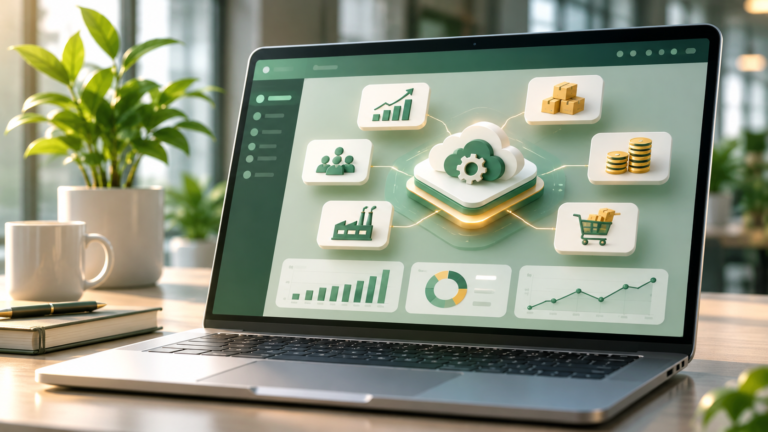
An ERP environment can bring business functions such as sales, customer management, inventory, procurement, finance and operations into a connected structure.
When these functions share consistent information, business leaders can better understand the relationships between transactions, operational activities and financial outcomes.
2. Intelligence Beyond Routine Reports
Business reports often explain what happened. Decision-makers also need to understand why a situation matters and what requires attention.
An intelligent ERP approach can help surface relevant exceptions, trends and potential risks, supported by available business data and clearly defined rules.
The objective is to make business information more useful for everyday management.
3. Better Visibility for Business Owners
Business owners and enterprise leaders should not need to interpret multiple disconnected reports to understand the state of their organization.
A well-designed ERP experience should help them navigate from an overall business picture to the underlying transactions and evidence that explain it.
This creates a more practical connection between business performance and management decisions.
4. Technology That Supports Business Growth
Organizations need systems that can evolve with their processes, reporting requirements and operational complexity.
ERP selection should therefore consider integration requirements, data quality, access controls, auditability, implementation needs and future scalability—not only the number of available modules.
How to Choose the Right ERP Software Company for Your Organization
Before selecting an ERP partner, ask these questions:
Does the solution fit your business processes?
The system should reflect how your organization actually purchases, sells, manages inventory and handles finance.
Can you trace important business information?
Reports and recommendations should connect to understandable records and evidence.
Can the system support your future needs?
Evaluate integration options, security, customization, performance and maintainability.
Does the partner understand business outcomes?
The objective should be better operational control and informed decisions, not simply implementing software.
Is AI being used meaningfully?
Look for practical business applications, explainable outputs, appropriate human oversight and measurable value rather than AI terminology alone.
Supporting Businesses Across South India
South India includes diverse business ecosystems, from manufacturing and wholesale distribution to textiles, trading, retail and other enterprise operations.
Organizations in Tamil Nadu, Karnataka, Kerala, Andhra Pradesh and Telangana may have different operational requirements, but many share common challenges: disconnected information, manual reporting, limited visibility and the difficulty of turning business data into timely action.
The right ERP approach should begin with those business challenges and then determine which technology capabilities are genuinely necessary.
For growing enterprises, this means evaluating both operational ERP capabilities and the intelligence required to make business information more useful.
Looking Beyond Traditional ERP
Choosing an ERP company is not just about selecting a software platform. It is about deciding how your organization will manage information, coordinate operations and support better decisions as it grows.
With its AI-native direction, iZU aims to bring operational management and business intelligence closer together—helping organizations move beyond recording what happened toward understanding what matters.
Explore iZU and discover a more intelligent approach to business operations.
Visit izuerp.com to learn more about iZU.
iZU is a product of IFARA Technologies, focused on engineering intelligent business solutions.